


Current and announcement
Hydrosexual Clinic III: An Affair with a Non-River
July 17 (Friday) and July 18 (Saturday), 2026, 1:00 p.m.–3:00 p.m.
Location: Rawa River promenade, Katowice
You arrange a hydrosexual date with the Rawa River – at 1 p.m., in the height of a scorching summer, on the blazing concrete of Katowice’s Market Square. Rawa whispers: “Don’t take pictures of me, sweetie. Don’t post me on your Insta stories. Let this be our experience.” Rawa is ugly and profoundly unphotogenic. She resembles a sewage canal. She is nothing like the San, the Krutynia, or the Wda. And yet you feel there is something that binds the two of you. Perhaps you, too, possess that repulsive charm? Perhaps you, too, are like a thin, foul-smelling thread only briefly attached to the Earth?
Katowice was founded on the banks of the Rawa. Yet it would be difficult to find another river with a longer history of deprivation in this region. Over the past two centuries, almost everything has been taken from her: her source, her riverbed, her natural current, her vegetation, her animals, her surface open to sunlight, and even her right to be called a river. Unlike the Oder, Rawa has never become a spectacular symbol of ecological disaster. She is described instead as a watercourse, a drain, a canal, a sewage infrastructure, or simply a “non-river.” Hidden beneath concrete, straightened, accelerated, confined within pipes, she has become one of the most radical inscriptions of the Anthropocene in the urban landscape. Today she survives as a hybrid organism with a narrow concrete smile.
The Hydrosexual Clinic is a performative patainstitution of collective healing, rest, and regeneration, initiated by do cyber_nymph Justyna Górowska and Ewelina Jarosz. Through playful, grassroots, and ironic appropriations of medical conventions, it proposes non-anthropocentric and non-ableist practices of care for both human and more-than-human bodies, while foregrounding public health in the context of climate and environmental crises. At the heart of the project lies hydrosexuality – a framework that reimagines embodiment and water while inviting playful, sensual relationships with the Blue Planet.
The third edition of the Hydrosexual Clinic invites participants to encounter the Rawa through affective, sensual, and embodied perspectives. We ask about the secret life of a river with whom we wish to enter into an intimate relationship. How can we love a river that has evoked disgust and revulsion for decades? How do we cultivate tenderness toward a degraded landscape? How might we expand our ecological imagination for a being whose subjectivity has been systematically destroyed? What lies beneath the layers of human shame surrounding the slow violence inflicted upon the river?
An affair with a non-river inevitably risks romanticizing – or Instagramming – ecological catastrophe. That is not the story we wish to tell. Instead, we embrace a practice of conscious anthropomorphization that allows us to approach an industrial river as a partner in co-creating infrastructures of more-than-human dialogue. We are interested in the river’s secret life: her memory, her currents, her whispers, her hidden desires, and the possibilities of future revitalization.
The third edition will take the form of the spectral clinic dedicated to the human and more-than-human inhabitants of the Rawa – those who are present, absent, and those who have not had the opportunity to exist. Through performative consultations, we will collectively diagnose our relationships with the river, prescribe hydrosexual remedies, and practice new ways of sensing dirty urban water. Together we will imagine the river’s future beyond the Anthropocene: slower, more permeable, inhabited once again by plants, animals, and humans who have learned to listen to her voice.
Curatorial text – Ewelina Jarosz, created as part of the art-reseach duo cyber_nymphs
Clinicicts:
Tomasz Maria(n) Dąbrowski – a post-performative conceptual artist operating at the intersection of reality, imagination, and interpretive misunderstanding. A symbiotic forest dweller and lover of living nature and fluid phenomena. They explore the pleasures of being in and around water, treating immersion – with or without clothing – as equally valid epistemic strategies. Professionally, they work as a cultural animator and serve as the lifebuoy of BWA Katowice. Fishing ideas out of the whirlpools of administration, they rescue the team from drowning in procedures and keep projects afloat in reality. An observer of events with an indeterminate ontological status. They are convinced that absurdity is the most sophisticated form of logic.
Justyna Górowska (she/her) – a hydrofeminist and performance artist working under the nickname WetMeWild, collaborating on interdisciplinary projects at the intersection of art, technology, and social activism. As a child, she fell in love with the aquatic creatures inhabiting the Skawa River in Poland. Her work has been exhibited internationally, including in Berlin, Jakarta, Warsaw, and New York. She received her PhD from the University of the Arts Poznań in 2020. Based in Kraków, she is affiliated with the Intermedia Department at the Jan Matejko Academy of Fine Arts and is an Assistant Professor in the Department of Digital Art and Multimedia at SWPS University in Kraków.
Ewelina Jarosz (she/they) – is a hydrofeminist researcher and artist co-creating artistic projects focused on water, and an Assistant Professor in the Department of Media and Cultural Studies at the University of the National Education Commission, Kraków (UKEN). Their writing explores environmental art, blue media, hydrofeminism, queer ecologies, and pleasure activism. They are a two-time recipient of the Kościuszko Foundation Fellowship and collaborate with the E.A.R.T.H. Lab at the University of California, Santa Cruz, and The Posthumanities Hub at Linköping University in Sweden.
Olga Kaszlewicz (she/her) – a collector of quiet moments of wonder inspired by the more-than-human world. She feels most at home where land meets water – along forest paths, beside mountain streams, and in places that still remember their original rhythms. She believes that attentiveness is one of the simplest forms of care. At BWA Contemporary Art Gallery in Katowice, she curates exhibitions and co-develops artistic projects, helping ideas navigate safely through the meanders of reality. Within the Hydrosexual Clinic, she explores ways of restoring intimacy with the river – not through grand gestures, but through presence, listening, and a glimpse of imagination.
Jessica Kufa – is a hiker, spoil-heap wanderer, and slag forager. She first encountered a river as a child while wading through a courtyard flooded by the Rawa River. Before that, she knew the river only through its smell, the sight of pipes, and a narrow crack in a concrete slab through which she could glimpse the flowing water. She thinks with small, polluted rivers while walking across disturbed landscapes. At BWA Katowice, she works as a Programme Department Specialist.
mariia lemperk (they/them, she/her, he/him) – loves the Black Sea. Originally from Odesa, Ukraine, their artistic practice unfolds at the intersection of the politics of memory and the body. Recently, they have focused on (un)controlled spaces of pain, performative archives, non-hierarchical structures, the deconstruction of gender, and the presence of queerness within today’s political and cultural chaos. They also enjoy focusing on pleasure – especially on its profoundly political dimensions. BWA Katowice resident, working on the projects “Kissing a Rock” and “PAIN GAME”.
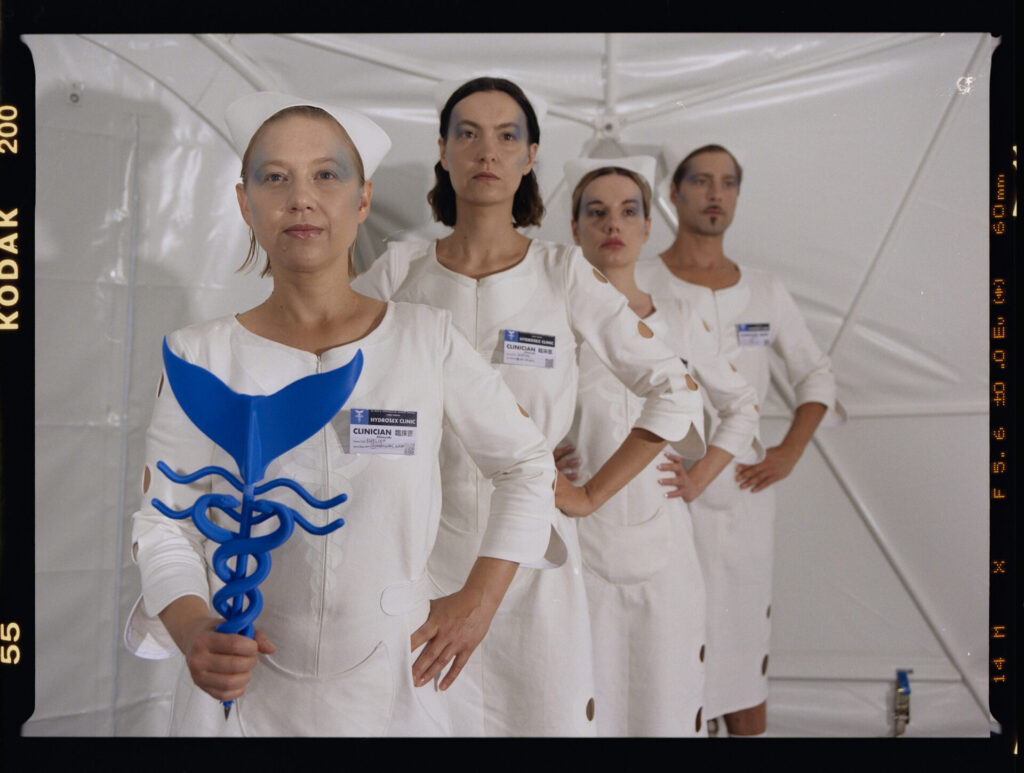
“Hydrosexual Clinic III: An Affair with a Non-River” takes place within the “Futurological Congress 2.0” series, dedicated to potential institutional scenarios, implemented within the framework of the “AESTHETIC CONGRESS”—a year-long series of exhibition and performance oriented activities aimed at updating the formula of art institutions, implemented with the involvement of diverse, complementary artistic languages and tools, and the participation of artists and curators. The primary point of reference and, at the same time, the starting point is the BWA Katowice, an institution imprinted at the heart of the city’s urban and social fabric as a tool of social engineering. The modernist pavilion, now a landmark, is a coeval symbol of the Polish wave of institutional critique. The need for its spatial and ideological updating becomes a starting point for a discourse on the meanings and dynamics of art institutions understood in a universal sense.
“AESTHETIC CONGRESS” curator – Łukasz Trzciński