


Current and announcement
Futurological Congress Seminar: “(Im)Possible Scenarios for Institutions”
April 24, 2026, 5:30 PM
We continue the series devoted to impossible institutional scenarios that have nevertheless managed to emerge with remarkable consistency. Following the first meeting with LIOS Labs (Desert Imagination Laboratory in the Błędów Desert), BWA Katowice invites another organization—the Świetlica Krytyki Politycznej w Cieszynie (Political Critique Community Center in Cieszyn).
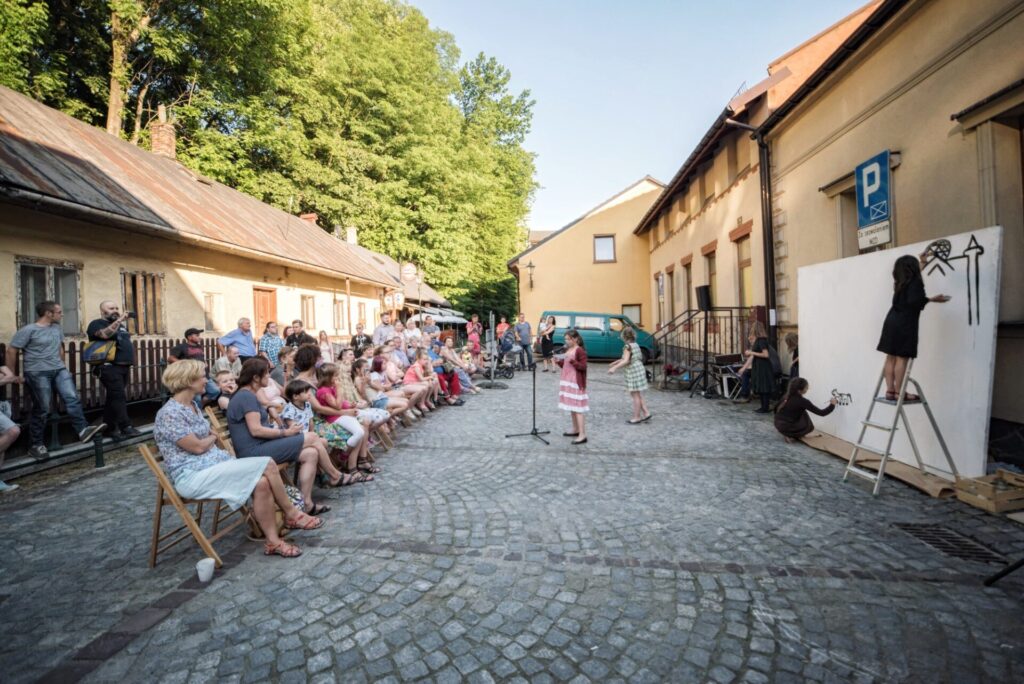
The Community Center is a social cultural institution that serves as a space for artistic, educational, activist, and research activities. Established in 2009, its first location was a former border guard building situated by the Olza River—the border between Cieszyn and Český Těšín. Since 2016, it has operated in the former Juwenia Knitwear Factory building in the so-called “Cieszyn Venice.” From the outset, the Center has combined artistic-research processes with educational and community-engagement activities involving local residents—primarily children and youth at risk of social exclusion.
The meetings devoted to the activity and experience of the Cieszyn Community Center take the form of open seminars. Together with invited guests, we discuss the ideas, events, and relationships underlying the institution’s work. The first meeting focuses on ethnographically oriented cultural facilitation, a perspective in which all facilitation activities are preceded by—or carried out through—an effort to understand and accept the social life and cultural experiences of diverse groups. The starting point for discussion will be the Community Center’s long-term collaboration with local communities.
The seminar is open—we invite anyone interested in the topic, including those working in cultural institutions, conducting cultural research, and leading artistic or facilitation processes. The session will be introduced by:
Natalia Kałuża – ethnologist, cultural studies scholar, and cultural facilitator. Coordinator of the Cieszyn edition of the WATCH DOCS Traveling Film Festival: Human Rights in Film. Head of the Political Critique Community Center in Cieszyn.
Joanna Wowrzeczka – artist (habilitation in fine arts) and sociologist (PhD in humanities). As a sociologist, she studies the field of art in Poland; as an artist, she addresses issues of domination and public space. Since 1999, she has worked at the Institute of Art at the Uniwersytet Śląski. Founder of the Political Critique Community Center in Cieszyn. Co-founder of the contemporary art gallery “Szara” in Cieszyn, where she served as curator from 2001 to 2005. Since 2018, a member of the Cieszyn City Council (2018–2023 term). In recent years, her artistic practice has focused on diagnosing social reality, addressing themes such as labor, politics, the city, and exclusion. She is an engaged artist, and much of her teaching takes place in public space, responding to its current challenges.
Tomasz Rokowski – professor at the Institute of Ethnology and Cultural Anthropology at the Uniwersytet Warszawski, affiliated with the Institute of Polish Culture at the same university, and a member of the Rada Doskonałości Naukowej. Ethnologist, anthropologist, and cultural scholar conducting research in Poland and Mongolia. His work focuses on the anthropology of poverty, grassroots development processes, anthropology of contemporary and participatory art, ethnographically oriented cultural facilitation, and contemporary methodologies in cultural research. He is also a physician specializing in emergency medicine and works in the Emergency Department of the Bielański Hospital in Warsaw.
The event is part of the “Futurological Congress,” implemented within the framework of the “Aesthetic Congress”—a year-long series of exhibition and performative events aimed at updating the formula of the art institution, carried out through the engagement of diverse, mutually complementary artistic languages and tools, as well as the participation of artists and curators. The primary point of reference—and at the same time the point of departure—is BWA Katowice, an institution embedded in the very center of the city’s urban and social fabric as a tool of social engineering. The modernist pavilion, now considered an architectural monument, is contemporaneous with the emergence of the Polish wave of institutional critique. The need for its spatial and conceptual updating becomes the starting point for a discourse on the meanings and dynamics of the art institution understood in a universal dimension.
Curator of the AESTHETIC CONGRESS – Łukasz Trzciński
Seminar program coordinator – Jessica Kufa