


Current and announcement
Rajzefiber 2026 — Hare and Hounds — Graduation Exhibition of the Academy of Fine Arts in Katowice
Art is reclaiming the Sculpture Gallery and expanding into new spaces within the BWA Katowice Pavilion! Celebrate with us!
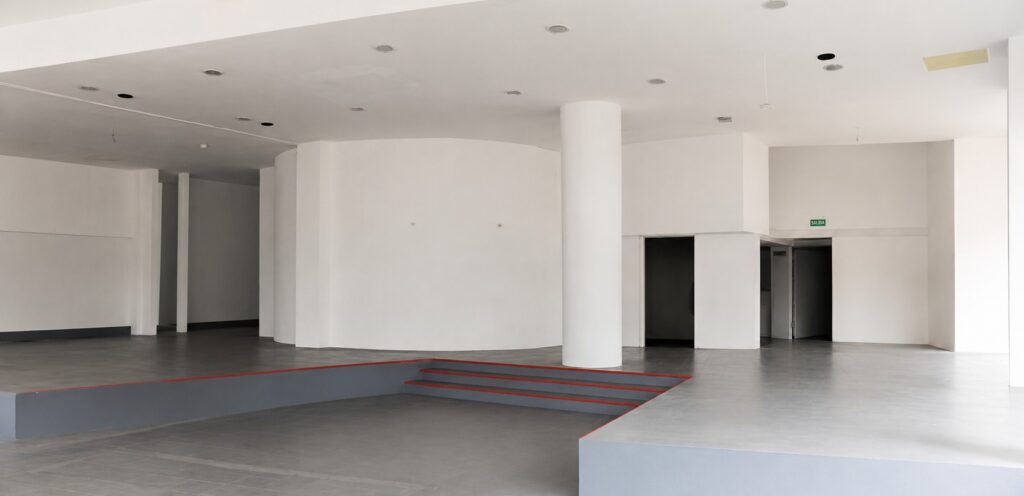
Art has entered new areas of the historic modernist BWA Pavilion, which until recently, by decision of the communist authorities, shared its premises with Cepelia (the Central Office of Folk and Artistic Industry). Spaces previously inaccessible to contemporary art are now being occupied for the first time by a young generation of artists — graduating students of the Faculty of Art at the Academy of Fine Arts in Katowice.
The works presented here not only document a moment of transition between education and the beginning of independent artistic practice, but also engage in dialogue with these recently vacated spaces, which have undergone multiple transformations and “lives after life.” Today, they are in the process of an irreversible (as we hope) transformation into spaces dedicated to art.
The result of several years of work is also a testament to the process of developing an individual artistic language, form, and way of relating to the surrounding world. The projects address themes closely connected to contemporary experience: memory, the body, relationships, technology, the environment, and everyday life. Each work approaches these subjects from a different perspective, and together they form a portrait of the concerns, discussions, and creative strategies that shape today’s emerging generation of artists.
This exhibition offers a unique opportunity to explore the diversity of attitudes and practices that define the contemporary young art scene, while also observing how these works resonate with new spaces for art, both physically and conceptually.
List of Graduating Artists
Ewa Babiarz
Julia Białek
Martyna Bonarska
Kajetan Bronisławski
Dominika Buchowicz
Marta Cesarska
Magdalena Czaplicka-Dziaduch
Marta Dudek
Alicja Gaszta
Dominik Gocyła
Weronika Janica
Ziemowit Jarecki
Mateusz Knysak
Violetta Kocik
Alicja Kozik
Natalia Nycz
Bartosz Ostrowski
Tymoteusz Pawłowski
Aleksandra Piekarz
Katarzyna Pośpiech
Aleksandra Przetak-Jabłońska
Anna Rumin
Yelyzaveta Sereda
Stefania Skłodowska
Kinga Sobkiewicz
Izabella Szawica
Malwina Szymocha
Marta Tokarz
Marta Walaszczyk
Katarzyna Warmuz
Julia Wiorek
Opening:
3 July 2026 (Friday), 7:00 PM
Exhibition on view until 21 July 2026.
The exhibition is open to visitors from Tuesday to Sunday. Admission is available on the hour at 12:00 PM, 1:00 PM, 2:00 PM, 3:00 PM, 4:00 PM, and 5:00 PM.
Admission is ticketed. Tickets can be purchased at the BWA Katowice ticket desk, located on the mezzanine level at the gallery’s main entrance.
Rajzefiber – Scavenger Hunt
From the very beginning, the 2021–2026 cohort’s time at university was marked by a profound sense of uncertainty, shaped by a rapidly changing world. We began our studies in the midst of the COVID-19 pandemic, unsure how many times our education would be interrupted by successive lockdowns. We met one another behind face masks, surrounded by the ubiquitous scent of hand sanitiser, and yet we still managed to build lasting friendships.
Not long afterwards, Russia launched its full-scale invasion of Ukraine. We welcomed new students into our community, who gradually became an integral part of our groups. Although the atmosphere slowly began to settle, the underlying sense of instability never fully disappeared, continually reignited by developments in international politics and rapid technological change—not least the emergence and widespread adoption of artificial intelligence.
Our graduation exhibition, the subject of this text, has likewise taken an unexpected form. Newly reclaimed vacant spaces—formerly occupied by a bank, a café, and a ceramics company—have become another challenge that we were unexpectedly called upon to face, and ultimately succeeded in embracing.
The works presented here, each forming part of a graduate project, draw in remarkably diverse ways on the realities that have shaped the past five years. Questions of identity recur throughout the exhibition, often imbued with a sense of nostalgia and addressing themes of belonging, gender, queerness, spirituality, and feminist strategies. The uncertainty brought about by overproduction and the increasingly urgent ecological crisis finds expression in speculative visions of the future—some post-apocalyptic, others imagining forms of coexistence and symbiosis between future beings and the natural world.
At the same time, the intensity and acceleration of the 2020s have encouraged experimentation with new media while also inspiring many artists to seek agency and tranquillity through traditional craft and material processes, often pushing those techniques beyond their conventional boundaries to discover new artistic possibilities.
It is difficult to avoid clichés when attempting to summarise such a diverse exhibition, but perhaps it is best understood simply as a compelling reflection of the dilemmas that shape contemporary life. We are different; we interpret the same reality through different experiences and perspectives. It is precisely this diversity that becomes the exhibition’s greatest strength and its most meaningful value.
“The end returns, only to drift away again.” I have chosen to quote one of this year’s graduating artists, Alicja Kozik. After all, this is an exhibition that marks a threshold. It concludes one chapter of artistic development while simultaneously opening new and unfamiliar territories. Along the way, it has brought us answers, moments of personal closure, and countless new questions that, from this point onward, we will each have to confront independently in our own artistic practice.
Ewa Babiarz